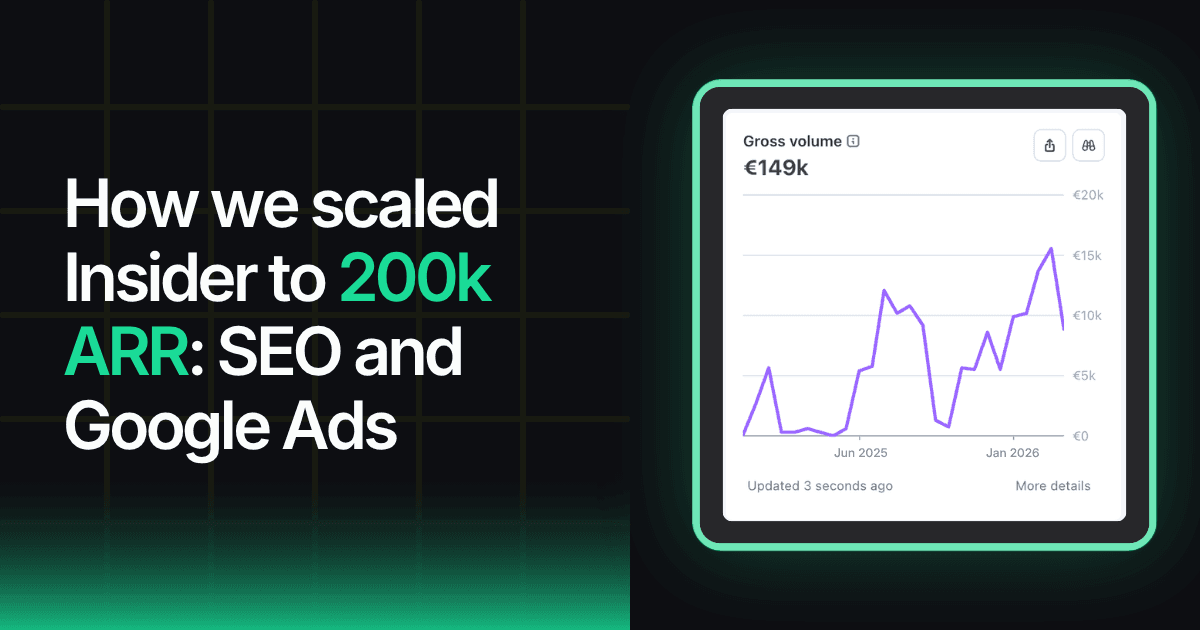
How we scaled Insider to €200k ARR: the SEO and Google Ads playbook
9 days ago - Szilárd
In late 2022 my co-founder Nicolas and I started building Insider, a SaaS for university entrance exam prep. Three products across three markets: BBE Insider (business school), WISO Insider (social-economics admission), GMAT Insider (international, MBA admission).
Two years later it crossed €200k ARR with just 10,000 users, a domain authority of 40+, and SEO contributing more revenue than paid ads.
Below is the playbook. The stack, the decisions, the numbers, what we'd do differently now.
The thesis
The decision that shaped everything was made in week one: build one acquisition system and one activation system, then keep optimizing them. No new channels until the existing ones faltlined.
The system had four parts:
- SEO foundation that could compound for years
- Google Ads as the controllable, paid layer
- Onboarding that maximized trial-to-paid conversion
- Analytics that told us what was actually working
Everything we built fit into one of those four boxes. Anything that didn't, we declined.
SEO: the foundation that compounded
We treated SEO as infrastructure, not content production.
Technical foundation. Next.js with ISR for fast page loads, static generation for the long tail, Core Web Vitals dialed in. Schema markup on every product page (Course, Quiz, FAQ). XML sitemaps generated automatically per locale. Internal linking built into the page template, not added manually.
The technical work took three weeks upfront. After that, every new page inherited the foundation for free.
Programmatic SEO. This is where Insider compounded.
Exam prep has natural long-tail search behavior. Students search for "BBE Prüfungsfragen 2024," "WISO Vorbereitung Beispielaufgaben," "GMAT Quant Practice Section 5." Each query is low-volume on its own. Aggregated across hundreds of variations, the volume is large and the intent is high.
We built three programmatic templates:
- Practice question pages, one per exam section, per year, per question type
- Topic deep-dives, one per testable concept, with linked practice
- Score guides, one per exam, with rankings and percentile breakdowns
Each template generated 50-200 pages. The pages had unique content (real questions, real explanations) and a consistent internal link structure. The content engine produced new questions monthly. Pages got fresher, rankings climbed.
By month 2 we ranked top 3 for over 40 commercial-intent queries across the three brands.
What we didn't do. No "10 tips for exam success" generic content. No keyword-stuffed blog posts. No content for queries we couldn't realistically rank for in 12 months. The discipline of saying no to obvious-but-bad content was as important as picking the right templates.
Google Ads: the controllable layer
SEO compounds slowly. Google Ads provides the immediate, controllable lever.
Campaign structure. Three campaigns per brand:
- Brand search (low CPA, high intent)
- Non-brand high-intent (exam name plus "preparation," "practice," "course")
- Competitor and alternative queries
Performance Max came later, only after we had clean conversion data feeding it. Launching PMax with bad conversion signal trains it on the wrong outcome and burns budget for months.
The conversion tracking decision. From day one, Google Ads optimized toward paid conversions, not signups. We imported Stripe paid conversions back into Google Ads with the actual subscription value. The algorithm bid toward revenue, not trial volume. Blended CAC stayed below €75 against an average customer LTV of €450+.
The keyword discipline. We added negative keywords more aggressively than positive ones. "Free," "PDF," "download," "torrent," "Reddit" all got negatived early. The cohort of users who clicked through "free PDF" queries never converted. Cutting them improved CPA without cutting volume.
Onboarding: where activation lived or died
Acquisition gets the user in the door. Onboarding decides whether they pay.
The trial structure. Free demo version, no card required. Valuable enough to feel the product, short enough to create more demand. We tested 3-modules and 7-module variants. 7 won on trial-to-paid conversion at every cohort cut.
The first session. Within 90 seconds of signup, the user had to complete one practice question and see one personalized result. If they didn't, they wouldn't come back. We pruned every screen between signup and that first interaction. Account verification moved to post-trial. Profile completion moved to a nudge. Tutorial got cut entirely.
The activation triggers. Three events drove paid conversion more than anything else:
- Completing the first practice session (within first 24 hours)
- Returning for a second session (within first 48 hours)
- Hitting a free limit (within first 5 days)
We instrumented all three in PostHog. Email lifecycle sequences and in-app nudges were built around them. If a user hit all three, trial-to-paid was 38%. If they hit none, it was 4%.
Pricing page. The pricing page is part of onboarding, not marketing. We tested 6 variants over 12 months. The version that won had: 3 tiers, one-time payment, money-back guarantee, FAQ block, tier comparison, payment logos. Stripped down to what removed friction at the decision point.
Analytics: the dashboard that ran the business
The dashboard was the artifact that made every other decision possible.
We used PostHog as the system of record. Three dashboards lived there:
- Acquisition. Sessions by source, conversion rate by source, CAC by source, retention by source. Updated daily.
- Activation. Signup-to-activated rate, time to first value, drop-off at each onboarding step.
- Revenue. MRR, churn, expansion, LTV by cohort, payback period.
Every Monday, we opened the same three dashboards. Decisions for the week came from there. Without it, we'd have been arguing about anecdotes for two years instead of moving numbers.
The numbers
By month 24:
- €200k ARR run rate, organic and paid combined
- 10,000+ users across three brands
- Domain authority 40+ across the brand cluster
- 200+ queries ranked top 3
- Blended CAC under €60
- Trial-to-paid conversion: 22% across all sources, 38% for activated users
- Organic share of revenue at peak: 64%
These are the numbers I show on sales calls when prospects ask whether the system actually works.
What we'd do differently
Three things, in order of cost.
Start programmatic SEO at week one, not month four. We hand-built content for the first quarter. That work was lost the moment we switched to templates. If we'd built the programmatic engine first, the index would have been four months ahead.
Set up Stripe to Google Ads offline conversion imports on day one. We turned this on after 12 months. The first 12 months of ad spend was optimized against the wrong signal. Not catastrophic, but not trivial either.
Build the PostHog dashboard before launching ads. We launched ads first, then built the dashboard a month later. We spent that month arguing about which channel was working. The dashboard would have ended the argument before it started.
How this maps to your SaaS
The specifics don't transfer. Exam prep isn't your vertical. The pricing model isn't yours. The seasonality isn't yours.
The structure transfers.
One acquisition system plus one activation system plus the analytics layer that connects them. Built once, optimized monthly. Compounding instead of campaigning.
The agencies that sold us "10 content ideas per month" or "Google Ads management" would have delivered a fraction of this. Tactics don't compound. Systems do.
If you're at €15k to €50k MRR and you've stalled, the bottleneck is almost never that you need more channels. It's that the channels you have aren't wired into a system that compounds.
This is the system I now install for SaaS clients at scalemysaas.com.
Keep reading
Google Ads conversion tracking for SaaS: the setup most founders get wrong
Most SaaS founders track signup, not paid. That's why their Google Ads bleed money. The 5-layer setup that fixes attribution and cuts CPA.
 Szilárd
Why 90% of SaaS Launches Fail (Even With a Great Product)
Most SaaS founders think they have a marketing problem, but what they actually have is a structural bottleneck: a product built without a demand engine.
Szilárd
The 3 Channels Every Technical Founder Should Master First
Stop spreading yourself thin. These are the highest-leverage channels proven to deliver predictable growth for early-stage SaaS founders.
SzilárdStop guessing. Install the system.
If your SaaS has product-market fit and growth has plateaued, book a call. 45 minutes. We'll know in the first 15 if we're a fit.
We take on 3-4 new clients per quarter. Calendar slots are limited.