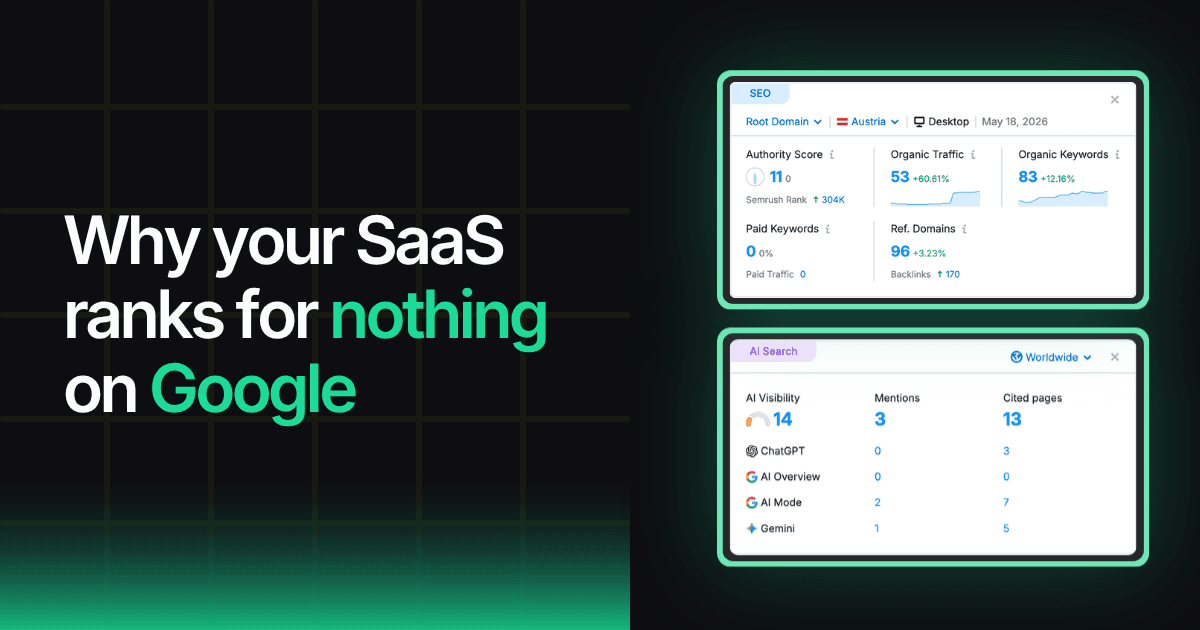
Why your SaaS ranks for nothing on Google: a technical SEO audit for founders
9 days ago - Szilárd
The standard SEO advice for SaaS founders is "produce more content." It's wrong, and it's why most SaaS sites rank for nothing two years after they ship.
Ranking isn't a content problem. It's a system problem. Your site is unindexable for the queries it should rank for, and the agencies you've hired weren't the ones to tell you.
Below is the audit I run on every SaaS site before writing a single page. Five layers, in order.
Layer 1: Technical foundation
Most SaaS sites have technical issues that quietly block ranking. The issues never make Search Console look red because Search Console doesn't surface them.
Indexation. Pull site:yourdomain.com in Google. Count the indexed pages. Compare against your total page count. If less than 60% of your pages are indexed, you have an indexation problem. Common causes: noindex meta tags on templates, blocked routes in robots.txt, soft 404s on dynamic pages, JS-rendered content the crawler can't see.
Core Web Vitals. Run PageSpeed Insights on your homepage, pricing page, and a sample blog post. LCP under 2.5s, FID under 100ms, CLS under 0.1. If any score is red, you're losing rank to faster competitors. Most SaaS sites fail on LCP because of unoptimized hero images and render-blocking scripts.
Crawl efficiency. Pull the crawl stats report in Search Console. If Google is crawling fewer than 100 pages a day on your domain, your crawl budget is constrained. Audit for: orphan pages, infinite parameter loops, duplicate URLs from query strings, sitemaps that don't match the live site.
Schema markup. SaaS pages should have Product, FAQ, BreadcrumbList, and SoftwareApplication schema where applicable. Most don't. Schema doesn't directly rank pages, but it's the difference between an organic result that takes 5% CTR and one that takes 12% because of rich features.
Mobile rendering. Open your site in Chrome DevTools mobile view. Confirm every page renders without horizontal scroll, with tap targets over 44px, and with no content blocked by sticky elements. Google indexes mobile-first. If mobile is broken, ranking is broken.
If any of these layers fails, no amount of content will fix it. Infrastructure first.
Layer 2: Information architecture
The second layer is the structure of your site itself.
A SaaS site should have three page types, each with its own URL pattern and template:
- Product pages. /product, /features/X, /integrations/Y. High commercial intent. Long-term ranking anchors.
- Use-case pages. /for/saas-founders, /for/agencies, /for/ecommerce. Captures different ICPs without dilution.
- Educational pages. /blog, /guides, /comparisons. Top-of-funnel, supporting authority.
The mistake most SaaS founders make is treating the blog as the whole SEO strategy. The blog is the easiest layer to build but the hardest to rank with for commercial queries. Commercial queries belong on product, use-case, and comparison pages.
Internal linking. Pull a crawl of your site (Screaming Frog or similar). Look at the link graph. Every commercial page should have at least 10 internal links pointing to it from supporting content. If your homepage has 50 outbound links and your highest-value product page has 3 inbound, the link equity is in the wrong place.
URL structure. Flat beats deep. /pricing beats /products/billing/pricing. Use hyphens, not underscores. Strip session IDs and query parameters from canonical URLs.
Layer 3: Keyword strategy
This is the layer where most SaaS founders skip the work.
Pick keywords in three buckets, in this order:
Bucket 1: Jobs-to-be-done queries. What your customer is trying to do, not what your product is called. "How to set up Stripe Connect for marketplaces." "Best way to track activation for SaaS." "How to reduce churn on annual plans." Mid-funnel queries with high commercial intent. They take 6-12 months to rank but they convert.
Bucket 2: Alternative and comparison queries. "X alternative," "X vs Y," "best X for Y." Lower volume per query but the conversion rate from a comparison page is 5-15x higher than a generic blog post. If competitors with high domain authority outrank you here, find smaller alternatives or "[category] for [specific use case]" variations.
Bucket 3: Programmatic queries. Long-tail, templated, often location- or vertical-specific. "[Tool] for [vertical]." "[Use case] in [industry]." Each query is low volume. Aggregated across 100-1000 pages, the volume is meaningful. Programmatic SEO works when the data exists to make each page genuinely unique. If your pages are 80% boilerplate, Google catches it and the pages don't rank.
Skip:
- Generic top-of-funnel queries you can't rank for ("what is SaaS")
- Branded queries for competitors (you won't rank, and intent is wrong)
- Pure informational queries with no commercial intent (low ROI on content investment)
Layer 4: Content engine, not content production
The mistake here is volume over system.
You don't need 50 posts a month. You need 5 well-targeted posts a month, each on a brief that maps to a keyword cluster, each interlinked with related pages, each updated quarterly.
The system:
- Keyword research feeds a content brief queue. Briefs sit in Linear or Notion. Each brief specifies primary keyword, secondary keywords, target word count, internal links to include, schema to apply.
- Writers write to brief. Whether that's you, a contractor, or a writer on your team, the brief constrains the output. No more "we'll see what comes out."
- Editor reviews against the brief. SEO checklist applied. Internal links verified. Schema added. Image alt text written.
- Publish, then track. Each page gets monitored monthly in Search Console for impressions and average position. After 90 days, refresh the page based on what queries it actually picked up versus what it was briefed for.
This is the engine. Output is downstream of the engine. Without the engine, content quality drifts and rankings don't materialize.
Layer 5: Programmatic SEO when the data supports it
Programmatic SEO is the layer that produces compounding traffic at scale, but it only works under specific conditions.
The data test:
- Is there a natural query pattern with hundreds of variations? ("[X] for [Y]," "[X] in [Y]," "Best [X] for [Y]")
- Do you have data that makes each page meaningfully unique? Real reviews, real pricing, real specs, real examples.
- Can you generate the pages from a template without producing thin content?
If yes to all three, programmatic SEO compounds for years. If no to any, skip it. Templated thin content gets caught and penalized.
The best programmatic SEO on SaaS sites:
- Integration pages (one per integration partner)
- Alternative and vs pages (one per competitor)
- Use-case pages (one per ICP segment)
- Location or region pages (one per geo, only if relevant)
What this audit produces
Run the five layers in order. You'll surface, in this order:
- The infrastructure issues that block ranking regardless of content
- The site structure problems that misroute link equity
- The keyword gap between what you target and what your ICP searches
- The content production pattern that wastes budget
- The programmatic opportunity, or the lack of one
By the time you've worked through this, you have a 90-day SEO roadmap with technical fixes, keyword targets, content briefs, and a programmatic decision. Implementation comes next. Without the audit, every piece of content you ship is built on shaky foundation.
If you want this audit run on your SaaS, the paid 1-week audit at scalemysaas.com produces it in writing, with a recorded walkthrough
Keep reading
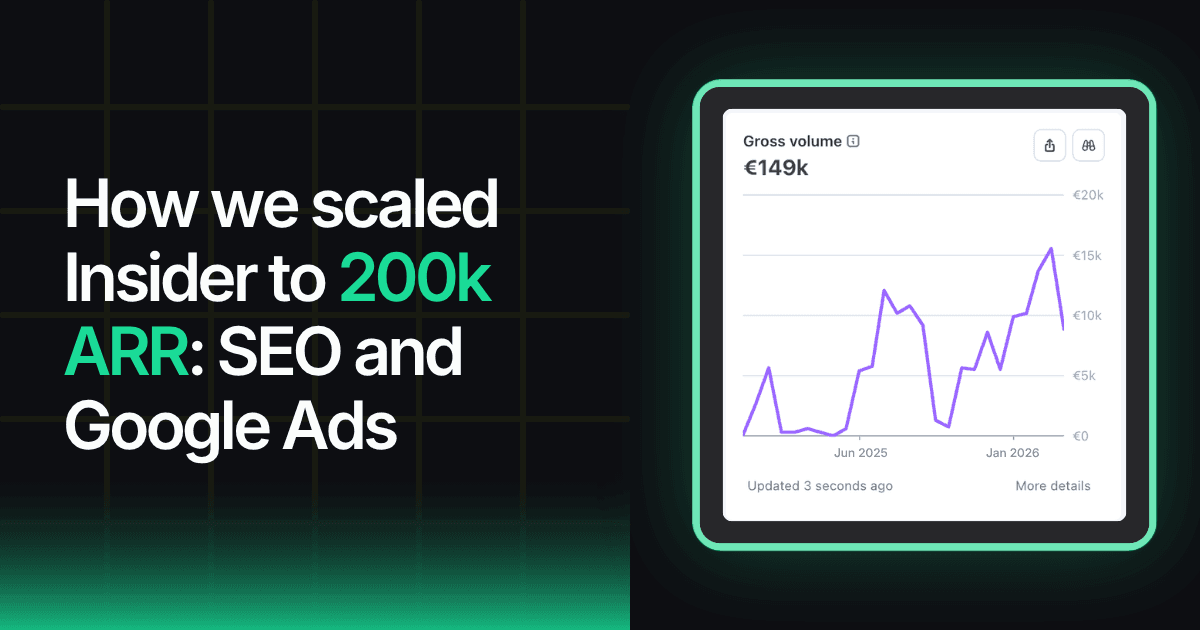
How we scaled Insider to €200k ARR: the SEO and Google Ads playbook
The SEO and Google Ads system that took Insider from 0 to €200k ARR over two years. Stack, decisions, numbers, what we'd do differently now.
 Szilárd
Google Ads conversion tracking for SaaS: the setup most founders get wrong
Most SaaS founders track signup, not paid. That's why their Google Ads bleed money. The 5-layer setup that fixes attribution and cuts CPA.
Szilárd
Why 90% of SaaS Launches Fail (Even With a Great Product)
Most SaaS founders think they have a marketing problem, but what they actually have is a structural bottleneck: a product built without a demand engine.
SzilárdStop guessing. Install the system.
If your SaaS has product-market fit and growth has plateaued, book a call. 45 minutes. We'll know in the first 15 if we're a fit.
We take on 3-4 new clients per quarter. Calendar slots are limited.