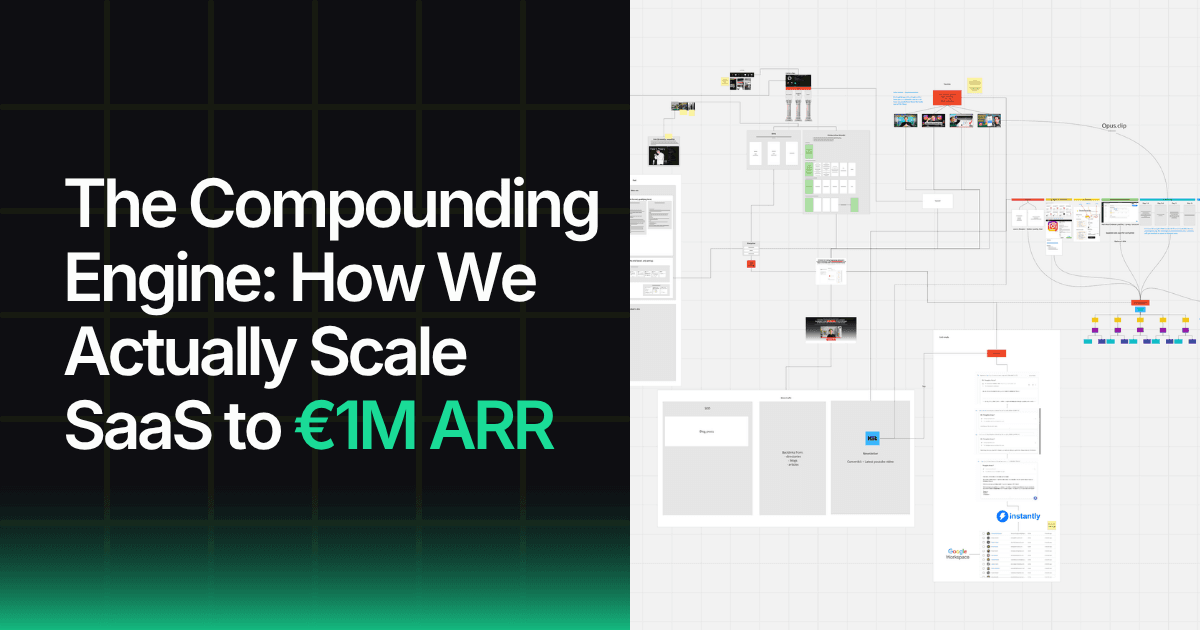
The Compounding Engine: How We Actually Scale SaaS to €1M ARR
6 months ago - Szilárd
Most SaaS founders past product-market fit are stuck for the same reason. They have channels but no system. They're running ads without proper attribution, ranking for nothing on Google, losing half their signups to broken onboarding, and they can't see clearly which channel is actually working.
This is the system I install to fix that. The same one I built on my own SaaS products before I sold it to anyone. Below is what it is, why it works, and the numbers it produces.
This is a long piece. If you're a SaaS founder between €15k and €50k MRR and your growth has flatlined, read it through. By the end you'll have a clearer picture of what's missing in your business than most agency calls will give you.
Part 1: Why most SaaS stalls at €15k to €50k MRR
The plateau between €15k and €50k MRR is the most common stall point in SaaS. Product-market fit is real. Paying users are real. The team has shipped. Revenue grows for the first 12 to 18 months on word of mouth and founder hustle. Then it flattens.
Founders blame the wrong thing.
The most common diagnosis I hear on sales calls is: "we need more channels." More content, more ads, more outbound, more partnerships. The founders who get to €1M ARR don't add channels. They build a system around the channels they have, and the system compounds.
The real bottleneck is one of four things. Usually all four.
1. You can't see what's working. Conversion tracking is broken or incomplete. Google Ads optimizes against signups instead of paid conversions. GA4 attribution is set to last-click. PostHog is missing or was set up by an engineer who left. Without clean data, every growth decision is a guess.
2. SEO produces nothing. The site has a blog with 40 generic posts that rank for nothing commercial. Programmatic SEO either doesn't exist or was templated badly and got de-indexed. Internal linking is missing. Technical SEO has issues that Search Console doesn't surface.
3. Google Ads is leaking budget. Campaigns optimize for the wrong conversion event. Bidding strategies are wrong for the data volume. Negative keywords haven't been touched in months. Performance Max was launched before the conversion data was clean.
4. Onboarding leaks paid conversions. Activation isn't defined. The first session has too many steps. Lifecycle emails are off the shelf. In-app activation triggers don't exist. The trial-to-paid conversion rate is half of what it could be.
Each one of these alone slows growth. Together they cap the business at the MRR ceiling that current effort can sustain. Doubling effort doesn't help. The ceiling is structural.
Part 2: Tactics vs systems
This is the distinction most agencies blur on purpose.
A tactic is a thing you do. "Run a retargeting campaign." "Write a blog post." "Send an email sequence."
A system is the infrastructure that makes tactics compound. A system has inputs, outputs, instrumentation, and a feedback loop. It produces tactics. The system survives when the agency leaves. The tactics die.
Most growth agencies sell tactics dressed as systems. They produce content monthly, manage ads weekly, and send reports showing "improvement" against vanity metrics. When the retainer ends, nothing they built keeps working. The dashboard they delivered was a Notion doc. The conversion tracking they set up was last-click GA4. The SEO foundation they built was 12 blog posts that decay in 18 months.
This is why so many SaaS founders have tried multiple agencies and "none of them worked." The agencies weren't selling them what they needed. They were selling effort.
A system has six properties:
- Infrastructure. Conversion tracking, attribution model, dashboards, documented playbooks.
- Compounding output. Each unit of work makes the next unit cheaper. New blog posts inherit the SEO foundation. New ad campaigns inherit the conversion data.
- Instrumentation. Every decision has a metric attached. The metrics live in one dashboard, not five.
- Feedback loop. Weekly reads of the dashboard inform monthly optimizations. Optimizations get logged.
- Survives transitions. If the operator leaves, the next operator can pick it up. Playbooks document what to do and why.
- Tied to revenue, not effort. Reports show MRR impact, not "content produced."
If what your current agency built doesn't have all six, you have tactics, not a system.
Part 3: The five layers of a working growth system
The system has five layers. They install in order because each layer depends on the one before it.
Layer 1: Conversion tracking and attribution
Everything else depends on this. Most SaaS founders skip it or hand it to engineering, where it sits in a Linear ticket for 6 months.
The stack:
- GTM for event capture, server-side for paid conversions
- GA4 for cross-channel attribution, data-driven model, conversion window matched to actual sales cycle
- Google Ads Enhanced Conversions for hashed first-party data
- Stripe to Google Ads offline conversion imports so the algorithm optimizes against revenue, not signups
- PostHog for product-level events: activation, feature adoption, retention by source
Each piece has a job. Together they tell you which channel drives retained, paying customers, not which channel drives the most signups.
The fix matters more than people realize. On one B2B SaaS client, turning on offline conversion imports cut blended CAC by 34% over 90 days. Same ad spend. Same product. Better signal.
Deep dive: Google Ads conversion tracking for SaaS: the setup most founders get wrong
Layer 2: SEO foundation that compounds
SEO is the channel that pays you for years if you build it correctly and pays you nothing if you don't.
The foundation has four parts:
Technical. Indexation, Core Web Vitals, schema markup, crawl budget, mobile rendering. None of this is glamorous. All of it has to be right or content doesn't rank.
Information architecture. Three page types: product pages, use-case pages, educational. URL structure, internal linking, link equity routed to the pages that close deals.
Keyword strategy. Three buckets: jobs-to-be-done queries, alternative and comparison queries, programmatic long-tail. No generic top-of-funnel content for queries you can't rank for in 12 months.
Content engine. A brief queue, a writer process, an editor checklist, a quarterly refresh cadence. Five well-targeted posts per month beats 50 generic ones.
Programmatic SEO is the multiplier when the data supports it. On Insider, three programmatic templates produced over 400 commercial-intent queries ranked top 3 inside 12 months. The pages compounded for the next 12 months without further investment beyond monthly content updates.
Deep dive: Why your SaaS ranks for nothing on Google: the technical SEO audit founders skip
Layer 3: Paid acquisition engine
SEO compounds slowly. Paid is the immediate, controllable lever.
The buildout:
- Brand search as the first campaign. Lowest CPA, highest intent. Always on.
- Non-brand high-intent search as the growth campaign. Jobs-to-be-done queries with commercial language.
- Competitor and alternative queries where competitors have weaker ad spend
- Retargeting to convert mid-funnel traffic
- Performance Max only after conversion data is clean. Launching PMax with bad signal burns budget for months.
The discipline that separates ad accounts that work from accounts that don't:
- Optimize toward paid conversion value, not raw signup volume
- Add negative keywords more aggressively than positive ones
- Match conversion windows to the actual sales cycle, not the default
- Bid by audience after 60 days of data, not by demographic guess
The math: a working Google Ads engine for a SaaS at €25k MRR should produce €5k to €15k in incremental MRR per month at a CAC below 6 months of LTV. If yours doesn't, the campaigns aren't the bottleneck. The signal is, or the keyword choice is, or the landing pages are.
Layer 4: Activation and retention
Acquisition gets the user in the door. Activation decides whether they pay.
The standard SaaS onboarding loses 40% of signups before activation and another 25% between activation and paid. The half that survives is the half your business runs on. The half you lose is where the next €1M ARR lives.
What gets installed:
Activation definition. One event, one metric. Insider's was "first practice session completed." Yours might be "first team member invited," "first dashboard published," "first integration connected." Lock it. Every report downstream depends on it.
First-session optimization. Strip every screen between signup and the activation event. Account verification moves to post-trial. Profile completion becomes a nudge. Tutorial gets cut. The goal is the user hits activation inside 90 seconds.
Lifecycle sequences. Email sequences mapped to activation triggers, not to time. "User signed up but hasn't activated within 24 hours" is a different message from "User activated but hasn't returned within 48 hours." Off-the-shelf welcome sequences are worse than no sequence.
In-app activation nudges. Triggered on inactivity, on partial activation, on score plateau, on feature drop-off. Less invasive than email but higher conversion rate when timed right.
Churn signal monitoring. Identify the leading indicators of churn (drop in usage, downgrade attempts, support tickets) and intervene before cancellation. Most SaaS waits until cancellation to intervene. By then the user has already decided.
On Insider, activated users converted to paid at 38%. Non-activated users converted at 4%. The activation system was the single highest-leverage piece of the install.
Layer 5: The dashboard that runs the business
The dashboard is the artifact that makes every other layer accountable.
Three dashboards live in PostHog:
- Acquisition. Sessions by source, conversion rate by source, CAC by source, retention by source. Updated daily.
- Activation. Signup-to-activated rate, time to first value, drop-off at each onboarding step.
- Revenue. MRR, churn, expansion, LTV by cohort, payback period.
Every Monday the founder and operator open the same three dashboards. Decisions come from there. Without the dashboard, the team argues about anecdotes. With it, the team argues about numbers, which is the only argument worth having.
The dashboard is also the proof that the system works. After 90 days, the founder can point at it and see what changed, what didn't, and where to invest next. The proposal you signed becomes a measurable contract instead of a vague promise.
Part 4: The math of building this vs buying it
The most common objection on sales calls: "this is expensive."
Compare it to the alternatives.
Hiring a head of growth. A senior growth hire in Europe is €120k to €180k fully loaded per year, plus equity, plus 3 to 6 months to ramp. They need to build the same system from scratch. Even if you hire the right person, you're 12 months and €150k from where this install gets you in 60 days.
Hiring a growth marketer. A €60k to €80k mid-level growth marketer can run a system, but most can't build one. You'll hire them, hand them no system, and they'll produce tactics for 6 months while you wonder why MRR isn't moving.
Running another agency engagement. A typical SaaS marketing agency charges €3k to €8k per month and delivers content production, ad management, and a monthly report. After 12 months you have €60k to €100k spent and no documented system. When you cancel, what they built stops working.
DIY. A founder building this themselves typically takes 12 to 18 months while their attention is split across product, sales, and team. The opportunity cost of founder time on infrastructure work usually exceeds the cost of hiring it out.
The full install runs €8k to €15k setup plus €3k to €5k monthly retainer for 6 to 12 months. Calendar Year 1 lands at €38k to €65k. Less than half the cost of a head of growth. Faster than building it yourself. Better than another agency.
The math that actually matters: if the install produces €2k in incremental MRR over the first 12 months, the system has paid for itself. At €25k MRR baseline, €2k in incremental MRR is an 8% lift. That's a low bar for a working system.
Part 5: What the numbers look like when this works
Insider went from 0 to €200k ARR in 24 months using this exact system.
The numbers at month 24:
- €200k ARR run rate, organic and paid combined
- 10,000 paying users across three brands
- Domain authority 40 across the brand cluster
- 400+ commercial queries ranked top 3
- Blended CAC under €25 against average LTV of €180
- Trial-to-paid conversion: 22% blended, 38% for activated users
- Monthly churn: under 4% on annual plans, 7% on monthly
- Organic share of revenue at peak: 58%
Full case study: How we scaled Insider to €200k ARR: the SEO and Google Ads playbook
For client work, the typical 90-day results look like:
- Conversion tracking moved from broken or partial to verified across five channels
- Blended CAC reduced 20 to 40% from baseline (signal change, not spend change)
- 50 to 200 new pages indexed and ranking for commercial-intent queries
- Trial-to-paid conversion lifted 30 to 60% from baseline through activation work
- One dashboard that the founder actually opens every week
These ranges depend on the starting state. SaaS with no conversion tracking sees the biggest CAC drop. SaaS with no SEO foundation sees the biggest indexation lift. SaaS with broken onboarding sees the biggest activation lift.
Part 6: Common objections, reframed
"We have an in-house team." Good. In-house teams are tactical operators, not system builders. The install gives your team a system to operate. The DWY upgrade includes team training so your team owns the engine after I leave.
"We tried an agency before, it didn't work." Most agencies sell content and campaigns. Did the previous one leave you a working dashboard, documented playbooks, conversion tracking that survived their exit? If not, you got tactics. You're hiring me to install something different.
"Can you guarantee results?" No, and I wouldn't trust anyone who does. I guarantee the install. The system produces results when the install is correct and the product has product-market fit. Anyone who guarantees specific MRR or specific keyword rankings is lying.
"It's too expensive." Compared to what? Hiring a head of growth is 3 to 4x more. Running another agency for 12 months is the same cost with worse outcomes. DIY is 12 months of founder time you can't recover. The install is the cheapest path to a working system at this revenue stage.
"What if it doesn't work?" If the install isn't complete and documented at day 60, you don't pay the final milestone. If the install is complete but your business doesn't grow, we'd look at product, market, or pricing, which I flag during the audit if I see it. The install isn't a fix for a broken product.
"Can we start with a smaller engagement?" Not really. Half a system is worse than no system because the parts don't compound. If budget is the issue, the paid audit at €1,500 exists for fast-growth SaaS at €10k to €15k MRR. Otherwise the full install is the offer.
Part 7: What this looks like operationally
The install runs 60 days. Five phases.
Phase 1: Audit and foundation (weeks 1-2). Full audit of current channels, funnel, and analytics. Conversion tracking rebuild. Attribution model setup. Activation audit.
Phase 2: SEO foundation (weeks 2-4). Technical fixes, keyword strategy, content brief system, internal linking, programmatic setup, first priority pages published.
Phase 3: Paid acquisition engine (weeks 3-6). Google Ads buildout, conversion imports, landing page recommendations, creative briefs, campaigns launched, first optimization round complete.
Phase 4: Activation and retention (weeks 4-7). Onboarding redesign, lifecycle sequences live, in-app activation triggers, churn signal monitoring.
Phase 5: Reporting and handoff (weeks 7-8). Dashboards delivered. Weekly reporting cadence. Documented playbooks. 6 to 12 month optimization roadmap.
Day 61, the retainer starts. Months 3 to 12 are optimization: ongoing ad management, content brief production, monthly strategy calls, dashboard maintenance, A/B test iteration.
By day 365, the system has compounded for nine months past install. The numbers are different.
Part 8: Who this isn't for
This isn't for everyone. The install fails predictably when:
- The product doesn't have product-market fit. Churn over 8% monthly, no organic retention signal, no word-of-mouth growth. No growth system saves a product that doesn't fit the market.
- MRR is below €15k. The math of the engagement doesn't work at that revenue level. The €1,500 audit is the only path for sub-€15k SaaS at €10k to €15k MRR with fast growth.
- The founder isn't the decision-maker. The install requires fast decisions and stack access. Multi-stakeholder buying processes with no clear owner break the timeline.
- The founder wants a magic bullet, not a system. The install is infrastructure. It compounds. It doesn't produce a hockey stick in 30 days. Founders looking for a quick fix should not buy this.
- The founder isn't willing to invest. The setup is €8k to €15k. The retainer is €3k to €5k monthly. If that math doesn't work for the business, the answer is to wait until it does.
I'd rather lose a deal than sell into a bad fit. Bad-fit installs produce bad outcomes and bad reviews, which hurt the next 10 deals.
Closing
If your SaaS is between €15k and €50k MRR, the growth ceiling you're hitting is structural, not effort-based. Adding effort without adding system produces more work and the same revenue.
The system is the alternative. SEO foundation that compounds, paid acquisition engine that optimizes against revenue, activation that converts more of the traffic you're already paying for, dashboards that make every decision accountable.
This is what I install. The track record across more than 10 SaaS products with over €1M in combined revenue produced says the system works when the product has product-market fit and the founder commits to the install.
If you want to find out whether your SaaS is a fit, book a call at scalemysaas.com. The call is free, the discovery is honest, and if we're not a fit I'll tell you.
Keep reading
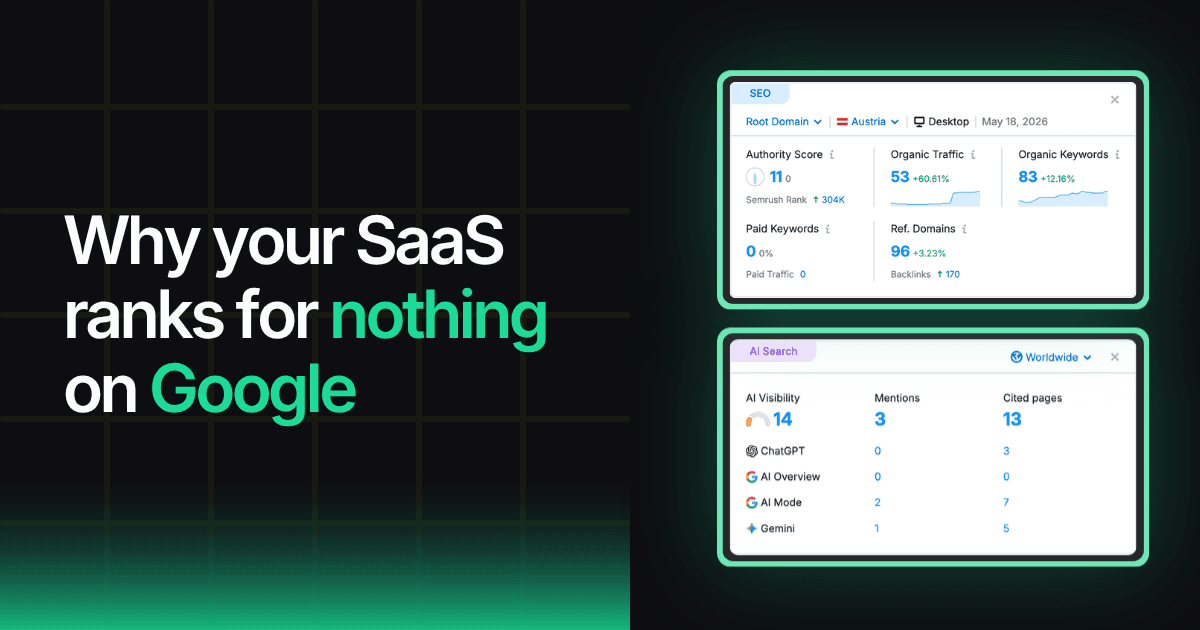
Why your SaaS ranks for nothing on Google: a technical SEO audit for founders
Most SaaS sites are unindexable for the queries they should rank for. The 5-layer audit and keyword strategy that fixes it, with no generic "build more content" advice.
 Szilárd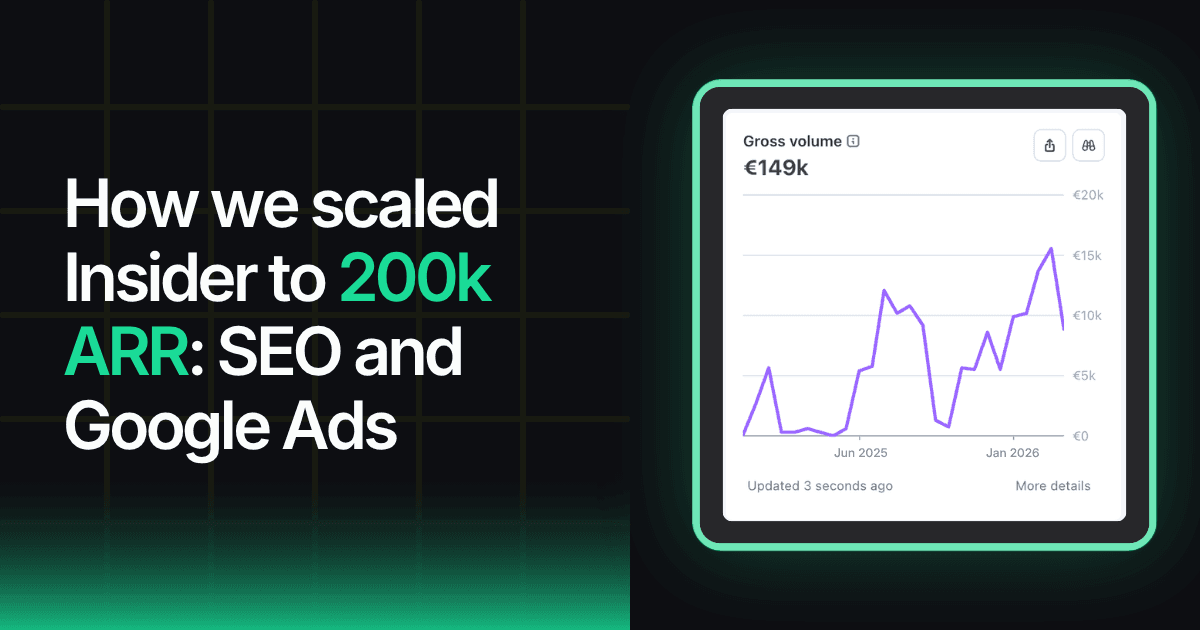
How we scaled Insider to €200k ARR: the SEO and Google Ads playbook
The SEO and Google Ads system that took Insider from 0 to €200k ARR over two years. Stack, decisions, numbers, what we'd do differently now.
Szilárd
Google Ads conversion tracking for SaaS: the setup most founders get wrong
Most SaaS founders track signup, not paid. That's why their Google Ads bleed money. The 5-layer setup that fixes attribution and cuts CPA.
SzilárdStop guessing. Install the system.
If your SaaS has product-market fit and growth has plateaued, book a call. 45 minutes. We'll know in the first 15 if we're a fit.
We take on 3-4 new clients per quarter. Calendar slots are limited.